

Video
Description
Embodied Interactive Performance
Chinese Short-term Cross-cultural Diaspora | Tides
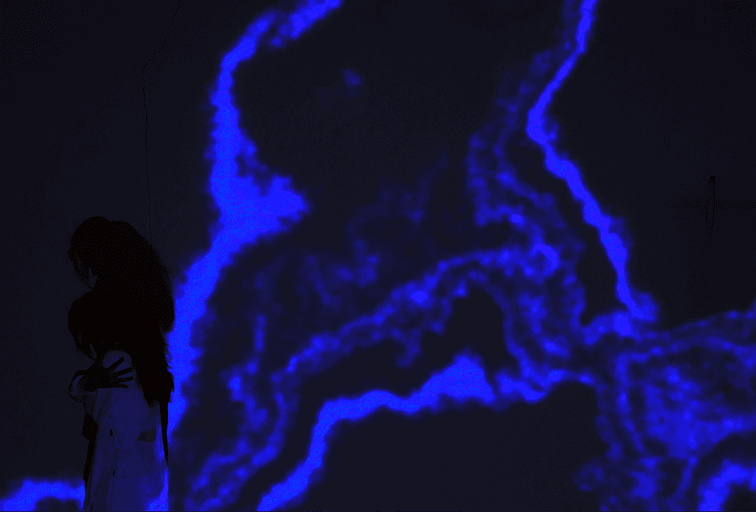
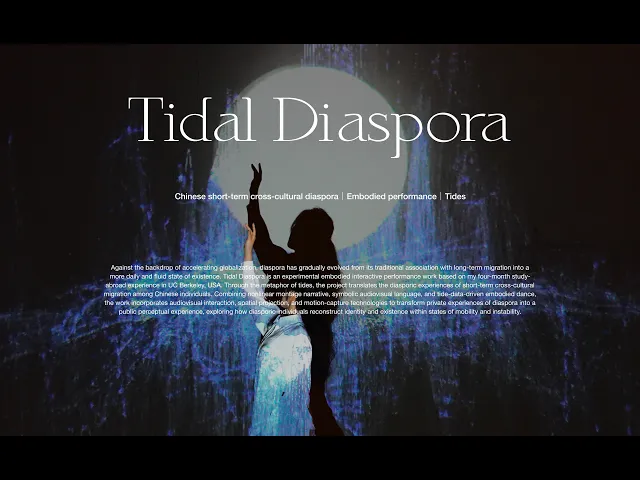
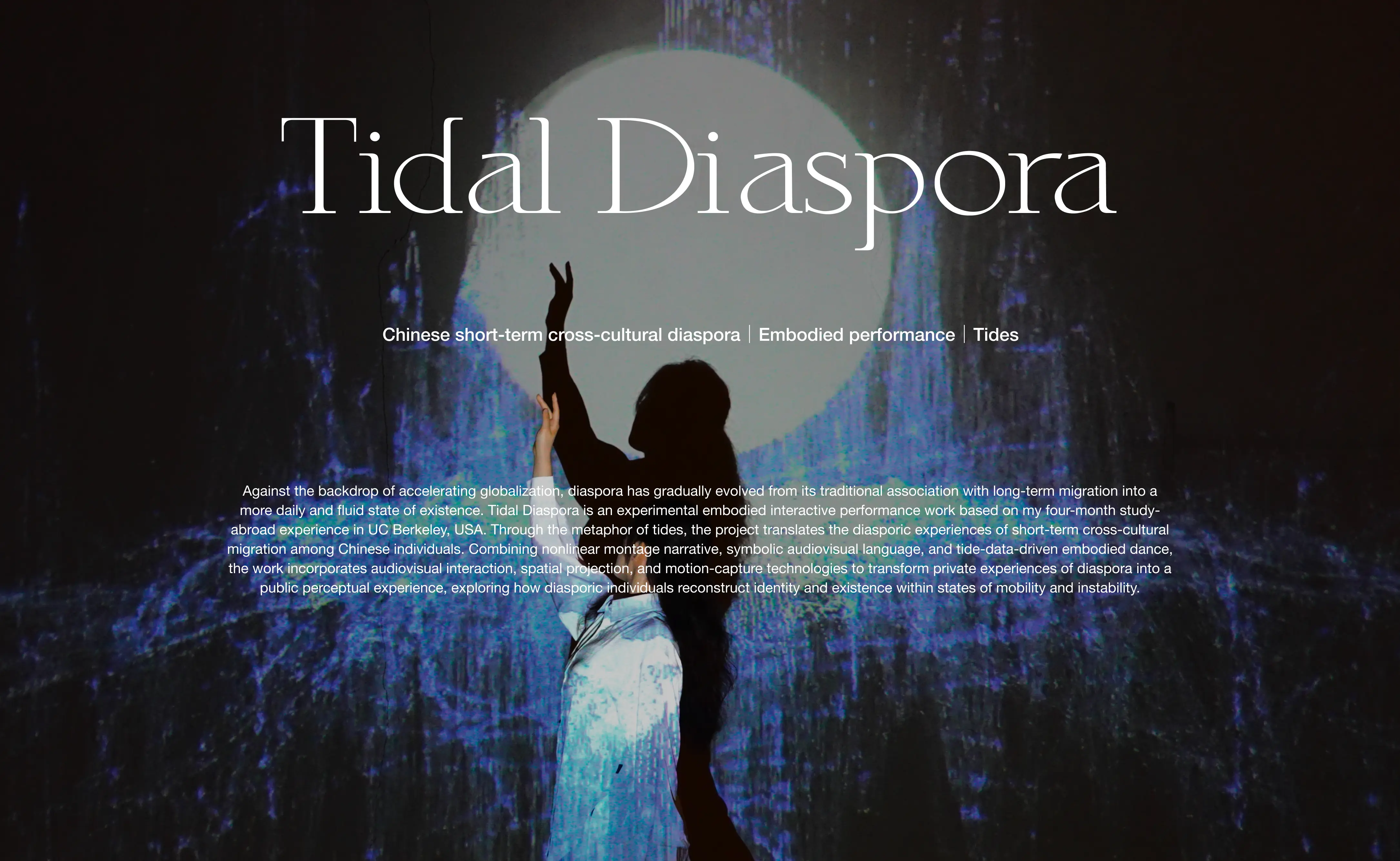
Against the backdrop of accelerating globalization, cultural diaspora has evolved from its traditional association with long-term migration into a more daily and fluid state of existence. Tidal Diaspora focuses on the diasporic experience within short-term cross-cultural mobility among Chinese individuals. Employing autoethnography as a research method and drawing on the author's four-month exchange experience at UC Berkeley in the United States as experiential material, the artwork translates diasporic perception into an embodied interactive performance through the metaphor of "tides." By integrating experimental narrative, audiovisual art, data-driven embodied performance, motion capture, and spatial projection technologies, the artwork constructs an immersive interactive environment that transforms private diasporic experiences into collective experience. Tidal Diaspora aims to explore how diasporic Chinese individuals reconstruct identity and existence amid mobility, while proposing a cross-disciplinary methodological approach to contemporary diaspora studies through new media art.

Key Takeaway & Innovation
Explore how diasporic individuals reconstruct identity and existence through mobility.
Investigate diaspora through an interdisciplinary framework integrating the humanities, social sciences, marine biology, and natural sciences.
Propose the embodied nature of diaspora then express diasporic experience through embodied performance and interactive new media.
Chapter I: Moon
I once heard a myth about the tides
God Thor was challenged to a drinking contest by the giant Loki
But he didn't know the horn was connected to the sea
So he kept drinking…

And The Tides Were Born
Chapter II: Diaspora
Berkeley was like a big forest
Sunlight, energy
But I just didn't know how to root myself in that soil

It took only five minutes to walk from my apartment to the nearest McDonald's
But walking through homeless people, smell of smoke
Made it the longest walk I'd ever taken

Sound: Tide laundry detergent advertisement at Target store

Sound: "Happy New Year" in 16 languages at San Francisco Chinatown

Chapter III: Emotion
Loneliness, Fear, Anxiety, Anger, Numbness

Chapter IV: Bridge
I thought the only way to stop the tides was to fly back to China
But when I went back
The tides were still there

Chapter V: Tide
Maybe the tides never stop
And maybe there's no escape

But in this tidal world
Every breath is a proof
That I exist

Chinese Diaspora
Diaspora has traditionally been understood as an "expatriate minority community," while James Clifford reconceptualizes it as a dynamic process in which identity is shaped by travel, dwelling, belonging, and borders. The Chinese diaspora has a long history and is one of the world's largest diaspora populations, with over 60 million people living across nearly 200 countries and regions. From the Gold Rush and the Chinese Exclusion Act to Reform and Opening-up and contemporary globalization, the Chinese diaspora has gradually shifted from long-term, survival-driven migration to short-term daily mobility. Situated within this historical transition, this artwork explores the lived experiences of contemporary Chinese individuals experiencing short-term cross-cultural diaspora, examining how identity is continuously negotiated through mobility.


Autoethnographic Materials
Tidal Diaspora employs autoethnography as a research method and drawing on the author's four-month exchange experience at UC Berkeley as experiential material, transforming personal diasporic experience into collective narrative of diaspora.


Tide as Metaphor of Diaspora
Tidal Diaspora constructs a mapping between the tide and diaspora through three dimensions: spatiotemporal, interpersonal, and sociocultural.

Narrative & Media
The artwork constructs five narrative chapters, each featuring corresponding visual, sonic, and performance design.

Technique

Embodied Performance
Traditional diaspora studies have primarily focused on identity at the level of consciousness, while overlooking a fundamental fact: diaspora is first experienced through body. Before it is reflected in consciousness, diaspora manifests as changes in bodily rhythms and sensory perception, including jet lag, dizziness, digestive disruption, and weightlessness. In response to this embodied nature of diaspora, this artwork adopts embodied performance as primary medium, mapping bodily movement onto diasporic experience. These mappings include gravitational movements corresponding to the pull of the tides, rise and fall movements corresponding to tidal rhythms, and gestures corresponding to emotional states.
A: Gravitational movements - Pull of the tides

Gravity

Weightlessness
B: Rise & fall movements - Tidal Rhythms

C: Gestures - Emotion

By Chenfei Liu
Contact: +86 17310140714
Email: chenfei2@andrew.cmu.edu